
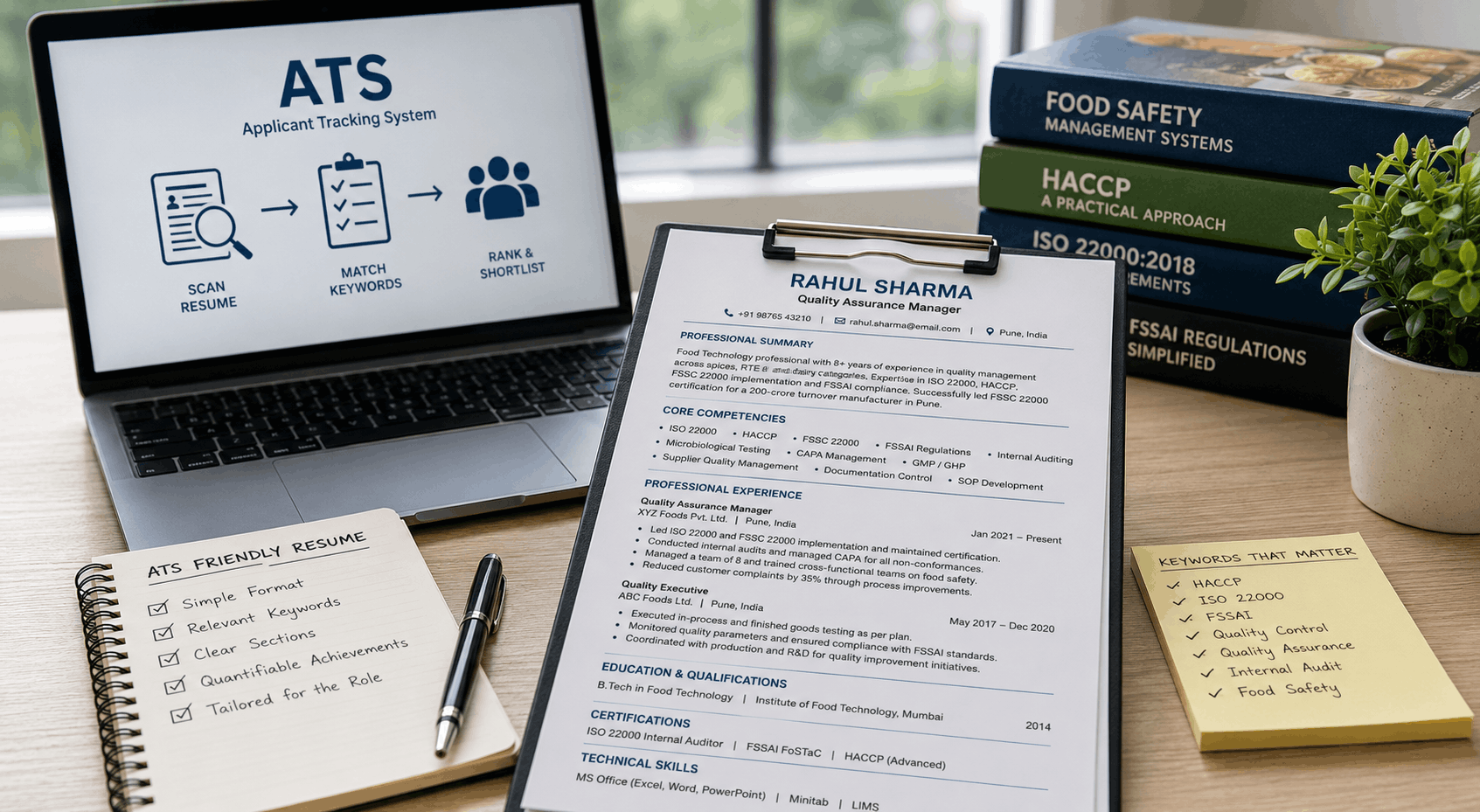
I have reviewed hundreds of resumes from food technology graduates and working professionals over the years. And the single most common problem I see is not lack of experience or poor qualifications — it is resumes that are visually impressive but practically invisible to the systems that screen them first.
Most large food companies in India — and almost all recruitment agencies working in the sector — now use Applicant Tracking Systems, or ATS, to filter resumes before a human recruiter even sees them. If your resume is not formatted and worded correctly, it simply does not exist in the hiring process. You applied, but you were never seen.
An Applicant Tracking System is software that parses, stores, and ranks resumes based on how well they match a job description. When a recruiter posts a job for a QC Manager with specific requirements — say, HACCP experience, ISO 22000 knowledge, and five years in food manufacturing — the ATS scans incoming resumes for those exact terms. Resumes that contain those keywords get ranked higher. Resumes that use different language, or that are formatted in ways the system cannot read, get filtered out.
For food industry professionals in India, this is particularly relevant because the sector has become more organised and corporate in its hiring practices. Companies like Nestle, ITC, Britannia, Parle, and large food manufacturing groups now run their hiring through structured digital pipelines. Even mid-sized manufacturers working with specialised food industry recruitment consultants are moving in this direction.
The most damaging thing you can do is submit a resume in a heavily designed format — multi-column layouts, text inside graphics, tables used as formatting tools, or PDF files with embedded fonts that the parser cannot read. What looks beautiful in Canva often looks like gibberish to an ATS.
Other common mistakes include using abbreviations without the full form (writing 'FSMS' without first writing 'Food Safety Management System'), leaving out specific certifications by name, and describing experience in vague language like 'handled quality activities' instead of specific, keyword-rich phrases like 'managed ISO 22000 internal audit programme' or 'conducted microbiological testing of finished goods per FSSAI standards'.
Use a clean, single-column format. Standard fonts like Arial, Calibri or Times New Roman in 10–12 point size. No tables for layout. No text boxes. No logos or images. Save as a .docx file unless the application specifically asks for PDF.
Your resume should follow this order: Professional Summary, Core Competencies, Professional Experience, Education and Qualifications, Certifications, and Technical Skills.
Write 3–4 lines that pack in your key identity as a professional. Mention your years of experience, the food categories you have worked in, your core functional area, and one or two standout achievements. For example: 'Food Technology professional with 8 years of experience in quality management across spices, ready-to-eat, and dairy categories. Expertise in ISO 22000 implementation, HACCP system management, and FSSAI compliance. Successfully led FSSC 22000 certification for a 200-crore turnover manufacturer in Pune.'
This is a keyword-rich section that ATS systems love. List 10–14 skills in a simple format. For a QA/QC professional, this might include: ISO 22000, HACCP, FSSC 22000, FSSAI Regulations, Internal Auditing, Microbiological Testing, Sensory Evaluation, CAPA Management, Supplier Quality Management, Documentation Control, GMP/GHP, SOP Development.
For each role, start with the company name, your designation, location, and dates. Then write 4–6 bullet points that are achievement-oriented and keyword-rich. Do not write 'Responsible for quality checks.' Write 'Conducted in-process and finished goods quality checks for 15+ SKUs across the spices range, maintaining batch rejection rate below 0.8%.'
Quantify wherever you can. Numbers stand out to both ATS systems and human readers. How many audits did you lead? What was the batch rejection rate before and after you implemented a process change? How many team members did you manage? What was the turnover of the plant you were responsible for?
Based on what food industry recruiters actually search for, make sure your resume includes relevant terms from this list as applicable to your experience: FSSAI, GMP, GHP, HACCP, ISO 22000, FSSC 22000, BRC, food safety, quality control, quality assurance, microbiological analysis, physicochemical testing, sensory evaluation, shelf life studies, vendor development, incoming quality check, in-process quality check, finished goods testing, CAPA, non-conformance report, internal audit, food safety management system, labelling compliance, raw material specification.
Tailor your resume for each application. Yes, it takes more time. But when a job description mentions FSSAI compliance and modern trade experience, those exact phrases should appear in your resume if they genuinely reflect your background. Copying the language of the job description — where it honestly applies to you — is not gaming the system. It is communication. You are making it easy for both the software and the human recruiter to see that you are the right fit.
India's food industry is hiring. Make sure your resume is actually in the room when that decision is being made.
