
If you have been browsing food industry job listings and keep coming across 'Modern Trade' as a functional area without fully understanding what it means, you are not alone. It is one of those terms that gets used constantly in FMCG and food industry circles but is rarely explained properly — not in college, and often not even during onboarding.
Let me break it down practically, because Modern Trade is not just a job category. It is one of the fastest-growing revenue channels for food brands in India, and the professionals who understand it are increasingly valuable.
Modern Trade refers to organised retail — the structured, professionally managed retail formats that operate with centralised buying, standardised processes, and sophisticated inventory and category management systems. In India, this means chains like Reliance Smart, Big Bazaar (now under Reliance), DMart, Nature's Basket, Spencer's, Star Bazaar, and the organised segment of wholesale trade like Metro Cash and Carry.
This is in contrast to General Trade, which covers the traditional kirana stores, small wholesalers, and unorganised retail that still account for the majority of food sales in India but operate through fragmented, relationship-driven channels.
As organised retail grows in India — and it is growing rapidly, driven by urbanisation, changing consumer behaviour, and the rise of large format retail in tier 2 cities — Modern Trade as a sales and distribution channel has become strategically critical for every food brand that wants to be taken seriously.
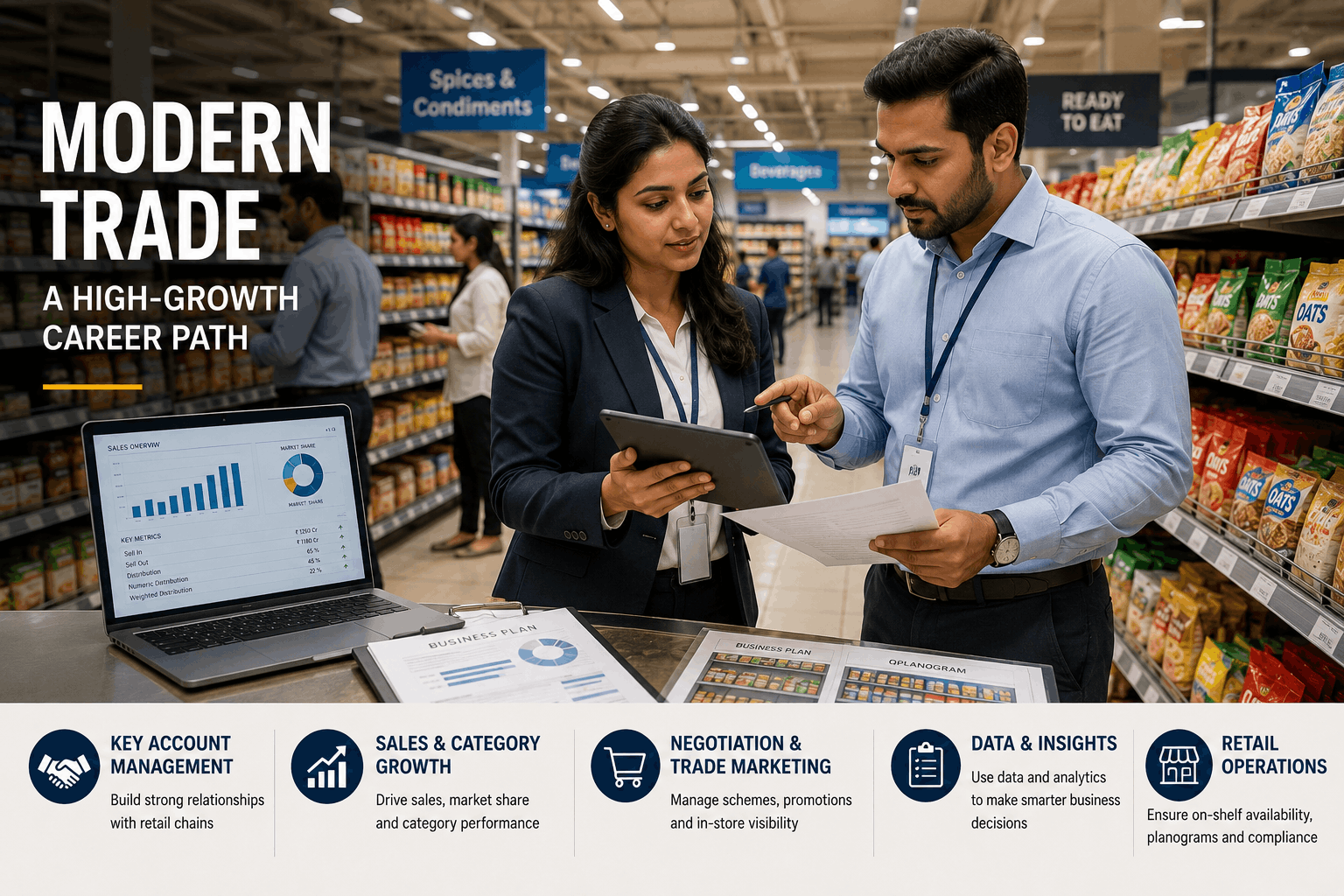
At its core, Modern Trade is a sales and key account management function. But it is significantly more analytical and structured than traditional FMCG sales roles.
A Modern Trade executive or manager is responsible for managing the relationship between a food brand and specific retail chain accounts — for example, being the point person for a spice brand's business with all Reliance Smart outlets in Maharashtra. This involves negotiating listing fees, promotional activities, shelf space, planogram compliance, trade schemes, and joint business planning with the retail chain's category team.
At more senior levels, Modern Trade managers handle annual business plans with key accounts, analyse sell-in versus sell-through data, manage trade marketing budgets, handle negotiations for gondola end displays and in-store promotions, and coordinate with supply chain to ensure on-shelf availability — because in Modern Trade, out-of-stock is a serious, relationship-damaging problem.
Strong analytical skills are essential. You will be working with sales data, market share data from Nielsen or IQVIA, and retailer-shared POS data constantly. If numbers make you nervous, Modern Trade will be a struggle.
Negotiation and relationship management are equally critical. Retail chains are tough negotiators. Understanding their KPIs — category growth targets, shrinkage reduction, gross margin improvements — and being able to speak their language is what separates average Modern Trade managers from great ones.
You also need solid knowledge of FMCG distribution economics — margins, trade schemes, payment cycles, return policies — and increasingly, an understanding of digital shelf analytics as modern retailers share more data with suppliers.
Virtually every organised food and FMCG brand in India has a Modern Trade function. Companies in spices and condiments, snacks and savories, ready-to-eat foods, dairy, beverages, and packaged staples are all actively hiring.
Roles range from Modern Trade Executives who manage field execution and merchandising to Area Sales Managers with Modern Trade focus, to Key Account Managers for national chains, to Modern Trade Heads who drive the strategic relationship with the country's top 5–10 retail accounts.
Most Modern Trade professionals start in General Trade or traditional sales roles and transition. The fieldwork experience — understanding how distribution works, managing territories, dealing with channel conflict — is genuinely valuable background.
However, freshers from management institutes with FMCG specialisations can also enter Modern Trade directly, particularly in analyst or junior Key Account Manager roles with larger companies. If you are a food technology professional considering a move into the commercial side, Modern Trade is one of the most intellectually interesting and commercially rewarding paths available.
Build your knowledge of retail metrics — ROI for retailers, category management fundamentals, planogramming — and demonstrate that in your interviews. Companies want Modern Trade candidates who understand the retailer's perspective, not just the brand's.
